Saturday, March 28, 2009

Touring Gettysburg with Tim Smith

Guide Tim Smith describes the actions of the 26th PA Militia in front of the group's monument on Chambersburg Street.

This weekend I had the opportunity to tour battle sites in and around Gettysburg with Licensed Battlefield Guide Timothy Smith via the Civil War Seminars through Harrisburg Area Community College. A great time was had by all and I know everybody in attendance learned a lot. We began in the morning with a talk by Jim Getty (as Abe Lincoln). We then had a classroom session with Tim followed by lunch and battlefield tour. (There were five speakers total and you can choose the one with the topic which interests you most.) About 150 people attended. Tim's topic discussed was the "forgotten" battle at Gettysburg - the skirmishes on June 26, 1863, several days before the major battle. All of the following information is from his presentation.

The battle on that day was "virtually bloodless," as Tim said, but very well could be considered the opening shots of the great battle. During this time, there was great fear in Pennsylvania and Harrisburg regarding Confederate Invasion. The previous fall, Jeb Stuart rode through Mercersburg, Chambersburg, Cashtown, fought a skirmish at New Salem (modern McKnightstown), and barely bypassed Gettysburg.

On June 15, 1863, Confederate General Albert Jenkin's cavalry captured Chambersburg, capturing free African-Americans and claiming them as "escaping southern property." The blacks who escaped dispersed throughout the countryside, spreading the word of invasion and fear throughout the region.

A short time later, Emmitsburg, Maryland was set ablaze and the people of the surrounding communities figured it was the Confederates. Actually, it was a drunk turned arsonist who burned down a saloon he was denied entry to. The fire spread and burned much of the town.

In Gettysburg, the "College Guards," a company of eighty students, was formed under Frederick Klinefelter, a student at the Lutheran Theological Seminary. Granville O. Haller, formerly the Provost under Gen. George McClellan, was on permanent leave in York when he heard of the invasion and offered his services to Governor Andrew Curtin. Haller intended to contain the invasion by falling trees, spying on the enemy, and blocking mountain passes. Haller's men, including five different groups of militia and troops from the area, built a barricade at Monterey. However, Jenkin's cavalry sneaked behind them and ran them off after a few shots. Haller's plan largely falls apart. Meanwhile, Col. William Jennings commanded the 26th PA Emergency Militia, composed of civilians from the surrounding counties.

Mr. Smith told us a very amusing story of a female farmer who lived west of Gettysburg. She lived on one side of a creek and her cow in a pasture on the other side. Every day, she brought the cow over to the house for milking. But, rather than wading through the creek, she slowly took the cow on the railroad bridge over the creek. Besides, she knew the train schedule and when it was safe to cross. June 1863, however, was a different matter. A train filled with troops and supplies of the 26th PA approached the town. The woman (who's name has been lost to history) was crossing the bridge with her cow in front of her when the train came speeding in from Harrisburg. Unable to move around the cow, she was forced to jump in the creek. The locomotive then hits the cow, the cow explodes, the train derails, and many militiamen were hurt! To add insult to injury, as one soldier tried to comfort the wet, crying woman afterward, a number of the militiamen pulled out their bayonets and helped themselves to some fresh ground beef...

Below are some photos of my adventures this weekend:

We started with Jim Getty as Lincoln at HACC.

26th PA Monument on Route 30.

This marker describes some of some of the fighting on June 26, 1863. It is on the northern side of Route 30 heading into Gettysburg from the west. It is in front of the salvage yard.

The Witmer Farm on Schriver's Corner Road.

Tim opposite of Witmer Farm - site of 26th PA's skirmish line.

Tim's point of view looking east. The building at center also belonged to the Witmer's but wasn't built until the 1870s.

I also checked out the Camp Letterman field hospital site this weekend. Unfortunately, the land has been cleared and looks like it is going to be developed.

And the old visitor center...

You can see the old entrance ways into the Electric Map in the far background. Much has been going on in Gettysburg these days. I'm anxious to see what the restored area will look like.

Wednesday, March 25, 2009

The Gettysburg Cyclorama

Okay, the picture above isn't a completely accurate photo. At right is Paul Philippoteaux, a famed French artist who painted the masterful Gettysburg Cyclorama (now refurbished and on display in the visitor center). The two guys on the other hand don't seem to fit in...for they are myself and my little brother. This picture was taken on the Grand Opening weekend in September and we stood in front of a green screen. Great photo, huh?

Anyway, I thought I'd share some cyclorama photos today. Most interestingly is a 360 degree viewer of the painting which was done during the restoration process. This one is really cool! Below are some more vintage images of the famous painting.

The first version of the painting, completed in 1883 and originally exhibited in Chicago, was lost for some time. It was rediscovered in 1965 and purchased by a group of North Carolina investors in 2007 for an undisclosed amount. Until November 2005, the second painting, originally exhibited in Boston, was on display at the Gettysburg National Military Park. It was removed for restoration work and the exhibition was reopened September 2008 in the new Gettysburg National Park Museum and Visitor Center. The third version, exhibited in Philadelphia, is known to have been destroyed. The location of the fourth version, originally exhibited in Brooklyn, is unknown.

http://tsla-teva.state.tn.us/cdm4/images/33297.jpg
Here is a view of the Cyclorama when in Nashville, TN.

http://www.mission66.com/cyclorama/images/boston.jpg
And in Boston. The painting inside this one is the one now in Gettysburg.

http://www.nps.gov/history/history/online_books/allaback/images/fig28.jpg
It was then moved to this building on Cemetery Hill in 1913 where it was nailed to the wall!

It was then moved to this one in 1961. It was on display here until 2005 when restoration began.
Below are some interior shots.


http://farm4.static.flickr.com/3158/3028554996_0dfe90e031.jpg?v=
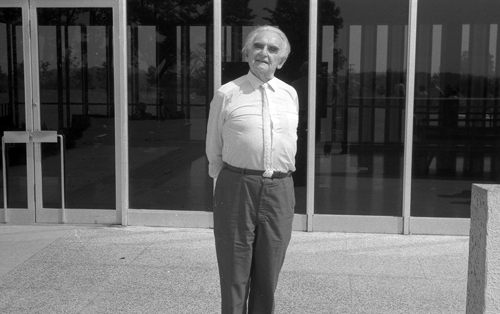
And here is Richard Neutra, designer of the '60s cyclorama building, as seen in front of his creation. This photo was taken in 1969, a year before his death. His family is trying to save the building from demolition, but I can't say I support their mission to do so. The building never fit into the rural atmosphere. Special thanks to the Center of Civil War Photography for this picture.

More pictures and video to come!

Tuesday, March 24, 2009

Museum Coming Down


By ERIN JAMES -
The Evening Sun, Posted: 03/24/2009

Alone on the sidewalk, Michael Waricher watched as a powerful crane gutted the building in front of him. Waricher was in Gettysburg by chance on Monday, the day demolition began on the former Gettysburg National Military Park Museum and Visitor Center on Taneytown Road.

A Carlisle resident and frequent visitor to Gettysburg, Waricher said he wasn't going to leave without witnessing the latest chapter in Gettysburg history. He said he supports the park's goal of demolishing the former museum, Cyclorama building and adjacent parking lots in an effort to restore the land to its 1863 appearance. "I'm glad to see it, quite frankly," Waricher said. "It's served its usefulness and it's time to move on."

As the crane ripped bricks, wires and insulation from the building, only a few looked on. The drivers of passing cars occasionally touched the brakes, and tourists sometimes peered across the wall of the Soldiers' National Cemetery for a few minutes to watch. But for most of Monday afternoon, the 88-year-old building came apart without an audience. By 3 p.m., the former museum was left with a gaping hole in its side. Eventually, there will be nothing left.

The Gettysburg Foundation, the park's private partner that operates the new museum, is paying a Maryland-based company, Interior Specialists, $800,000 to demolish both the former visitor center and, eventually, the Cyclorama building.

But the fate of the Cyclorama building, which once housed the 360-degree Cyclorama painting of Pickett's Charge, depends on the outcome of a federal lawsuit that pits the park against a preservation group that hopes to save the structure. Officials have said that demolition project will wait until the lawsuit is settled. The demolition project is one part of a plan that dates back nearly a decade to restore the 6,000 acres of Gettysburg battlefield within the park's boundary to its appearance in 1863. The Gettysburg Foundation is paying Maryland-based company Interior Specialists $800,000 to demolish the former Gettysburg National Military Park Museum and Visitor Center and, if the Park Service prevails in a federal lawsuit, the Cyclorama building too will be demolished.

For years, the park has proceeded with that plan by removing trees from places where they didn't exist at the time of the battle, when Civil War soldiers fought on open land. Telephone poles and utility lines have been relocated underground so as not to impede on a history student's perspective.

Next on the list for rehabilitation is the area where the former visitor center, Cyclorama building and parking lots are located. The 43.5 acres of land, known as Ziegler's Grove, was key to the fighting on the battle's third day.

Working behind the counter of Gettysburg Souvenirs and Gifts on Steinwehr Avenue, Cheryl Mickley said she was "saddened" to hear that demolition had begun at the former museum. "I hate to see it go," she said.

Even though the former museum closed nearly a year ago - when the new visitor center on Baltimore Pike opened - the building's pending demolition makes final what many Steinwehr Avenue business owners objected to when the park's plan was first proposed.

Some worried the museum's relocation would deter tourists from visiting the nearby street lined with stores, hotels and restaurants. And, according to many accounts, that's exactly what's happened. "It has made an impact," Mickley said. "We felt that last summer."

But the economy and high gas prices last year also factored in, she said, adding that business owners are optimistic for the upcoming tourist season. Leaning on the wall that separates Soldiers' National Cemetery from Taneytown Road, longtime friends Pat Blaser and Gerry O'Brien watched the demolition happening across the street.

Both men said they understand the former museum had passed its prime. But they said they wished the new museum could have been constructed in its place.

"It's a shame," Blaser said. "I really did like this place, but it wasn't big enough." Blaser, who lives in Hershey, Pa., said he'll also miss the Electric Map. "It really gave you a great lay of the land," he said.

O'Brien, a Gettysburg resident, agreed. He said he'll miss leaving the walls of the museum and walking right onto the battlefield. "I would have preferred that they had the new one here as well," he said. "I liked the fact that people could walk across the street to the National Cemetery."

ejames@eveningsun.com. Photos by James Robinson.

Monday, March 23, 2009

Saving the First Day's Battlefield

Above: For God's Sake Forward by Don Troiani. Below: Gen. James Archer

After eight years of federal funding cuts, Gettysburg National Military Park is finally receiving some additional money for operating costs and landscape restoration. Additionally, the park may now be able to fill its seventeen vacant positions, which they were previously unable to replace after those workers moved on or retired.

As it turns out, this new money may be used to purchase the former Gettysburg Country Club, a golf course which was the scene of intense fighting on July 1, 1863 between the Federal Iron Brigade and the Confederate brigade under the commander of General James Archer, who was captured on this site by a Private Patrick Maloney of the 2nd Wisconsin. After the advance of the Iron Brigade, there was a counterattack unleashed upon them by Gen. James Johnston Pettigrew and his command of North Carolinians. Obviously, this terrain is highly valuable land both historically and monetarily. I sincerely hope it is not turned into a housing development and that the Park Service or Civil War Preservation Trust may be able to preserve this significant site. The following is yet another fine article from the Hanover Evening Sun:

Funds make country club purchase possible again

Gettysburg National Military Park has $2.2 million to spend on land acquisition, and the Gettysburg Country Club is a high priority on the list of potential purchases.
By ERIN JAMES
The Evening Sun

For the first time since 2001, Gettysburg National Military Park has a budget that includes money for land acquisition - to the tune of $2.2 million.

And, if the pieces fall into place, some of those funds could potentially be used to purchase an easement to protect the Gettysburg Country Club from further development. "At the moment our goal is to discuss an easement," said park spokeswoman Katie Lawhon. But the park might consider outright purchase if an easement limiting development weren't possible, she said.

The 120-acre golf course is listed as a high priority on the park's list of properties within its 6,000-acre boundary but not owned by the National Park Service. In Gettysburg, that is true of about one out of every six acres. But properties are not always up for sale, and when they are, the park does not always have the funds to make a purchase. "Now we've got both of those, potentially," Lawhon said.

The Gettysburg Country Club fell into financial distress last year, and the bank ultimately foreclosed on the property. It went up for sale at a sheriff's auction for a minimum of $2.79 million in February, but no one placed a bid. That transferred the property back to Susquehanna Bank as the new owner. At the time, the bank's attorney implied that the property would eventually be up for sale. "Banks don't operate golf courses," Eugene Pepinsky said.

The park had been in discussions about purchasing the property with the club's previous owners, but an agreement was never reached. Now that the property is for sale and the funds are available, Lawhon said the park will likely try again. "I think it shows that there's certainly a greater chance," she said.

The Gettysburg Country Club was the site of significant fighting during the Battle of Gettysburg. On the first day of the battle, the famed Iron Brigade attacked across Willoughby Run onto what is now the golf course, driving back a Confederate brigade and capturing its commander, Gen. James Archer. Later in the day, Confederate Gen. James Pettigrew's North Carolina brigade advanced across the golf course to attack the Iron Brigade near the run. Both brigades lost more than 1,000 men that day.

If the park does succeed in acquiring the property, it couldn't come at a better time for some preservationists. Earlier this week, the Civil War Preservation Trust (CWPT) released its annual History Under Siege report, which names the top 10 endangered Civil War battlefields. As usual, Gettysburg is on the list. But this time, the Gettysburg Country Club is specifically named as a property at risk of further development. "We'd love to see it preserved," said Mary Koik, spokeswoman for the CWPT.

Like the park, the CWPT has also inquired about purchasing the property, but Koik said the asking price is just too high. In other words, there's no guarantee the country club will go from the bank to a group, like the park or the CWPT, interested in preserving it.

It's also not the only property the park could use the $2.2 million land-acquisition funds to purchase. The country club is one of 80 parcels of land within the park not owned by the Park Service. Of those 80, 33 are listed as high priority.

Lawhon wouldn't comment specifically on what other parcels are on the park's radar. Again, it depends on whether there's a willing seller, she said. "If somebody wants to talk to us about selling an easement or selling their property, we want them to call us," she said. "It's not going to do us any good if the owners aren't interested in talking to us."

Lawhon said the park received word of its $6.5 million 2009 budget just recently. In addition to the $2.2 million for land acquisition, the budget also includes an increase of $689,000 for park operations and $200,000 for battlefield rehabilitation. About $152,000 of the operations increase is allocated for fixed-cost increases, such as salaries, and the rest is allocated for additional programming, Lawhon said.

The operations budget increase is welcome news, Lawhon said, because the park has for years not been able to fill positions when employees left or retired. The result is a total of 17 vacant positions in Gettysburg, she said. "That (increase) is a direct response to that concern," she said. "There's so many vacant positions because money has been so tight."

ejames@eveningsun.com

Thursday, March 19, 2009

Joshua Chamberlain's Home

This past summer, my family and I had the opportunity to tour New England. Of course, we had to stop at the home of Civil War General Joshua Chamberlain. What is now the Joshua Chamberlain Museum was the family home beginning in 1859 when they bought this house. What is now the second floor of this building was originally the first floor. The general had the home raised and a whole other floor built underneath it! Pretty impressive for those times I think! Upon Chamberlain's death in 1914, his daughter, Grace Dupee, unfortunately auctioned off the general's collection of books, furniture, and military artifacts. (What was she thinking?) Some of these artifacts have been recovered, but mostly not. For many decades, the home was trashed as a dormitory by students at Bowdoin College. It was not until The Killer Angels novel and the movie Gettysburg was released that local citizens realized the historic treasure they had in their community. The home was saved.

Here is the main hall of the home. The little white knob on the wall is a thermostat at an angle at which Chamberlain could reach it due to his war wounds. Notice the original dinner gong to the upper left of the stairway.

This is one of the upstairs studies/bedrooms in which the Chamberlain children may have resided.

This is Chamberlain's original Civil War saddle, a very impressive artifact. At the bottom of the case is a photo of him mounted on his valiant steed, Charlemagne, also known as "Charlie Maine" by locals.

In another case are Chamberlain's boots which he wore at Gettysburg. When one looks closely, they can see the patch placed on a boot when a piece of shrapnel hit it on Little Round Top. The sword to the right was one of his swords, but not the famous bent one he used at Gettysburg. That one was auctioned off in 1914 and never recovered. There is nothing left of his uniform except the buttons, which are displayed in the background.

Here is the original bullet which went through Chamberlain at Petersburg. The wound was nearly mortal. After his recovery, Joshua gave the bullet to his brother, Tom, for it was he who saved Chamberlain and forced surgeons to operate on Joshua when the doctors thought Chamberlain was beyond saving.

This is Chamberlain's office, including his original inkwell. The big red chair at left was his governor chair. This chair was thought lost, but was actually found being used to throne the prom queen once every year at Bowdoin College! Needless to say, they quickly found another chair for the prom queen!

The completely refurbished living room.

A view looking towards the front door and rear of the staircase.

Across the street in the Bowdoin College Library, you can find Chamberlain's Medal of Honor.

And of course, I had to go pay my respects to the general himself...

Saturday, March 14, 2009

Exploring PA's Civil War Flags: Part II

There are also Civil War flags in the rotunda of the PA capitol. Outside the main entrance is an equestrian statue of Gen. John Frederick Hartranft (1830 - 1889). Remembered as "Old Johnny" by the troops he commanded, Hartranft became the second of Pennsylvania's Civil War heroes to become governor after the war. This statue was dedicated in 1899 by his men.

To find the flags still in the capitol, walk in the main rotunda and
walk behind this statue at the front of the main staircase...


...To the side rear of the staircase, you will find two of these cases. There are about ten of these cases in the rotunda, all originally installed to house flags, but they now display other artifacts. The remainer of the flags are in a nearby facility as shown in part I of this post. There are about 25 flags in this particular case, each identified by the tags tied around the top of them.

Click to zoom in and read the text of the display.

Up the staircase is a statue of Civil War Governor Andrew G. Curtin, perhaps the most important of the Federal state executives. Curtin formed the vital Loyal War Governors' Conference of 1862 and helped establish the Gettysburg National Cemetery.

Across the street is the State Museum of Pennsylvania,
which devotes an entire gallery to the Civil War in Pennsylvania.


Included in the exhibit is a Gettysburg cannon and Peter Rothermel's famed panoramic
painting of Pickett's Charge. There is much more to explore here as well.

This only scratches the surface of Harrisburg's Civil War Heritage.


Wednesday, March 11, 2009

Clash at East Cavalry Field

Today's video is from the documentary feature Horses of Gettysburg. This particular segment depicts the fierce horseback fighting which took place on East Cavalry Field. 8,000 men and 8,000 horses from the Union and Confederacy's mounted armies met in one of the largest cavalry battles of the Civil War. Years before his famous stand at Little Big Horn, General George Armstrong Custer was known as a fearless cavalry commander. His encounter with the forces of Confederate General J.E.B. Stuart on the East Cavalry Field helped to determine the outcome of the Battle of Gettysburg. Enjoy!

Sunday, March 8, 2009

Exploring PA's Civil War Flags


On a few occassions, I've had the opportunity to explore the Pennsylvania Civil War flags collection near the capitol in Harrisburg. Thought I'd take the time to share some stories and photos with you all. The following summary is courtesy of Capitol Preservation Committee. Click any of the photos below to enlarge them.

"Hundreds of heroic stories surround Pennsylvania's Civil War battle flags. More than 300,000 Keystoners answered the call for duty during one of America's most trying times. In the initial days of the war, the Pennsylvania Legislature convened in a special session to provide for the defense of the Commonwealth. Among the new acts passed was one authorizing Governor Andrew G. Curtin to procure battle flags for each regiment that Pennsylvania contributed to the Union Army. Most regiments carried several flags issued either by the state or federal government.

After the war, Pennsylvania's military department was responsible for collecting the state-issued flags. Many of the colors were collected as the regiments mustered out of service. On July 4, 1866, the battle flags were officially returned to the custody of the Commonwealth. On that memorable day, Pennsylvania Civil War veterans, representing the state's 215 regiments, took part in a spectacular parade through the center of Philadelphia, culminating in an impressive ceremony at Independence Hall.

The following day the flags were moved to Harrisburg, where the colors were stored in special cases in the State Arsenal building. In 1872, the Legislature appropriated money to furnish a flag room on the second floor of the Hills Capitol. The flag room was completed in 1873 where these treasured relics remained until 1894. At that time they were removed to the newly erected Executive Library and Museum building (now known as the Speaker Matthew J. Ryan Building).

Twenty years later, June 14, 1914, after architect Joseph M. Huston had finished the new Capitol building, Pennsylvania veterans came together once again to transfer their flags back to the Capitol building.

In a heartrending ceremony, the aged warriors placed the colors in custom-made flag cases in the main rotunda. The flags were kept virtually untouched until 1982 when the Capitol Preservation Committee initiated its "Save the Flags" project. Throughout the years dust had accumulated on the rolled flags, and the long-term vertical display of the flags had placed severe stress on the brittle silk fabric and painted designs. Textile conservators carefully removed the flags from the rotunda and transported them to a state facility near the Capitol.

Over a period of five years, 390 Civil War and twenty-two Spanish-American flags were conserved. Each flag is now kept on an acid-free panel stored in custom designed, stainless steel storage units. The flags are protected from light, dust, fluctuating temperature, humidity, and excessive handling."

This particular cavalry guidon belonged to the 7th PA Cavalry, in which one of my Civil War ancestors served. Sgt. Sylvester Weakland (related through my father' side) was a blacksmith in the regiment and shoed the horses of the regiment.

The flags are kept on these acid free shelves and covered in a tissue paper-type material. Each regiment has its own shelf (or shelves) for their respective flags. You can see the other trays covered up in the background.

They also have the the flag staffs in a special drawer cabinet. Here is one that was struck by a bullet in battle. Phew, that was a close one!

Here are some more. More than one has battle damage.
You can see the other pull-out drawers which hold more of the poles.


I have more photos and information to come on this historic and often overlooked gem from Civil War Harrisburg. I encourage you all to visit this site and other historic ones when you are in the area.

Friday, March 6, 2009

Picture of the Week


Dinner time! This 1913 photo shows many Civil War vets lined up for chow at the 50th anniversary ceremonies. The young uniformed guys at center are Boy Scouts whose jobs were to help the aged veterans get around. I bet they all ate well, huh? (Click to enlarge.)

Wednesday, March 4, 2009

Farewell to the Old Museum


The information booth at the former visitor center for Gettysburg National Military Park is today a scattered mess of papers and brochures. Crews from Maryland-based Interior Specialists began working recently in preparation for the old museum s demolition, which officials expect will begin in the next three to four weeks. (Evening Sun Photo by James Robinson )

Some of you may have read my post the other day concerning the removal of the old park visitor center. Below is a recent article regarding the demolition of the site:

Old Gettysburg Visitor Center in its last days

But the Cyclorama building, also scheduled for demolition, will remain until the park settles a federal lawsuit with a preservation group hoping to save it.
ERIN JAMES
The Evening Sun

In hallways where thousands of schoolchildren and tourists once crowded together, the exhaled breath of a lone visitor now hangs visible in the cold, empty air. The heat was long ago turned off at Gettysburg National Military Park's former museum and visitor center, which, with a pending fate of demolition, is merely a shell of its former self. Today, the place is an eerie mess, full of empty shelves, scattered papers and outdated brochures.

Forgotten coffee mugs and an empty vending machine linger in the break room. Old lockers and mailboxes left behind still bear the names of park employees. A poster left hanging on an upstairs wall advertises the 2008 opening of the new museum and visitor center on Baltimore Pike.

The new center opened last April, but there is unfinished business at the former museum on Taneytown Road. Recently, crews began the process of inspecting, and ultimately, demolishing the 88-year-old building.

Within a month, workers will begin to demolish the center piece by piece, said Gettysburg Foundation spokeswoman Dru Neil. The Gettysburg Foundation, the park's private partner that operates the new museum, is paying a Maryland-based company, Interior Specialists, $800,000 to demolish both the former visitor center and, eventually, the Cyclorama building.

But the fate of the Cyclorama building, which once housed the 360-degree Cyclorama painting of Pickett's Charge, depends on the outcome of a federal lawsuit that pits the park against a preservation group that hopes to save the structure. Neil said that demolition project will wait until the lawsuit is settled.

In the meantime, though, demolition is a certain fate for the former museum.

As for how long it will take, Neil said that has yet to be determined. But the contractor expects to begin dismantling the building in the next three to four weeks, she said. The demolition project is one part of a plan that dates back nearly a decade to restore the 6,000 acres of Gettysburg battlefield within the park's boundary to its appearance in 1863.

For years, the park has proceeded with that plan by removing trees from places where they didn't exist at the time of the battle, when Civil War soldiers fought on open land. Telephone poles and utility lines have been relocated underground so as not to impede on a history student's perspective.

Next on the list for rehabilitation is the area where the former visitor center, Cyclorama building and parking lots are located. The 43.5 acres of land, known as Ziegler's Grove, was key to the fighting on the battle's third day. In addition to the demolition, the Ziegler's Grove project calls for the underground relocation of 6,700 feet of power lines and a rehabilitation of the landscape as it once was.

The total cost of the project is estimated at more than $9.5 million, but the Gettysburg Foundation has committed $7 million from fundraising efforts. The remaining $2.5 million, park officials hope, will be allocated by Congress from federal funds. With so many factors, Neil said it is tough to say when the project will be completed - or even when officials hope it will be.

In fact, much of the planning phase is on hold until the buildings are demolished and officials can get a good look at the land left behind, she said. "This is so early on in the project that we still don't have a timeline or anything yet," Neil said. "This is very, very, very step one."

http://extras.mnginteractive.com/live/media/site140/2009/0303/20090303_065532_030309-JR-OLDVS2_3675794_300.jpg
Fencing now surrounds the former Gettysburg National Military Park museum and visitor center on Taneytown Road. Crews are expected to begin demolition in the next three to four weeks. (Evening Sun Photo by James Robinson )

Tuesday, March 3, 2009

Big Bucks for Programs


Good news from the battlefield. The David Bruce Smith Education Initiative has donated one million dollars to the Gettysburg Foundation and the park for interpretive programs related to Abraham Lincoln. Perhaps it would have been better used for battlefield preservation or restoration, but just the same, it is great news for park programs.

$1 Million will pay for park programs

By ERIN JAMES
The Evening Sun

The Gettysburg Foundation plans to spread out a $1 million gift over the next 10 years for a series of Abraham Lincoln-related programs, scholarships and distance-learning activities. The foundation, which operates the new Gettysburg National Military Park Museum and Visitor Center, recently announced its receipt of the donation from the Robert H. Smith Family Foundation.

According to a press release, the programs will debut this year and will be centered at the visitor center, Soldiers' National Cemetery and at other Gettysburg sites. The 10-year effort is being called the David Bruce Smith Education Initiative, named for Robert Smith's son. Robert Smith is a Virginia-based businessman and philanthropist who Gettysburg Foundation spokeswoman Dru Neil said often makes donations for history education.

Although the donation is expected to pay for a decade's worth of programming, Neil said the foundation wanted to capitalize on the attention to Lincoln's 200th birthday this year. "The timing could not be better," she said. "We definitely wanted to get started now."

Scheduled so far for this year is a walking tour of Lincoln's visit to Gettysburg, which will take visitors to the Lincoln Train Station on Carlisle Street, the David Wills House where Lincoln stayed the night of Nov. 8, 1863 and to the cemetery where the 16th president delivered his famous Gettysburg Address. The self-guided tour brochure will be available beginning in April.

A summer series of theatrical and musical performances will also be held at the visitor center. In the fall, special tours focusing on the Gettysburg Address and Lincoln's 1863 visit will be held at the cemetery.

Finally for 2009, a statue of Lincoln will be unveiled Nov. 19 - the 146th anniversary of the Gettysburg Address - at the visitor center. Distance-learning activities - when Gettysburg officials broadcast history lessons to classrooms across the country - are also part of the initiative and will pay for Lincoln-related curriculum, Neil said.

"Those have been wildly, wildly popular," she said. The initiative will continue in 2010 with public programs, an annual lecture and a portable exhibit on Lincoln and his speech.