Summer is winding down and so is my time left in Gettysburg for this season. However, that's not slowing us down in our adventures. Yesterday Barb Sanders, the park's education specialist, took us interns on a field trip to various "behind the scenes" places throughout the park, most of which the public doesn't have access to. One highlight of our trip yesterday was a visit to the George Spangler Farm, the site of an 11th Corps field hospital after the battle. Just within the past year or so, this property was purchased by the Gettysburg Foundation for $2 million. It is in the long term plan to restore this property and have it become part of the park. The site is very pristine, with original fixtures and all.
According to the Gettysburg Foundation, "the 80-acre farm-bounded by Granite Schoolhouse Lane and Blacksmith Shop Road, between Taneytown Road and Baltimore Pike-is located at what was the logistical center of the Union battle line during the three-day Battle of Gettysburg in July 1863. During and after the battle, the site also served as a field hospital, treating Union and Confederate wounded alike and providing the grounds for temporary interment of deceased soldiers. It was at the George Spangler Farm that Confederate General Lewis Armistead died of the wounds he suffered at the High Water Mark on July 3. He also was buried there...
During the July 1863 Battle of Gettysburg, the George Spangler Farm was the setting for some of the most significant battle support functions that contributed to the Union victory. The farm, located at the logistical center of the Union battle line, is bounded by two local roads-Granite Schoolhouse Lane and Blacksmith Shop Road. These two were among the busiest of the local roads used to supply troops, artillery and ammunition during the three days of battle. The farm also is connected by Granite Schoolhouse Lane to two major logistical highways-Baltimore Pike and Taneytown Road. Because of these factors, the Union command selected the farm as its closest-and most important-artillery and ammunition support facility. Timely artillery support from the Spangler Farm was instrumental in helping the Union Army hold the high ground on July 2 and achieve victory July 3. Infantry support from the Union 5th and 12th Corps moved across the fields of the farm-and along the local roads that border it-in their hasty rescue of the beleaguered Union battle line on July 2.
The farm also saw service as a field hospital, both during and after the battle. Before sundown on July 1, 1863, the wounded of the Union's 11th Corps found their way to the farm, where surgeons established the division's hospital. This hospital remained in active use throughout July, treating Union and Confederate wounded and also providing the grounds for temporary internment of deceased soldiers. It was in a small outbuilding on the Spangler Farm that Confederate General Lewis Armistead died of the wounds he suffered at the High Water Mark on July 3. He also was buried on the property.
The selection of the farm as a location for the field hospital was based on the size of the buildings on the property, its relatively protected position from enemy artillery fire, its supply of well water, the large and accessible farm fields, and its promixity to Baltimore Pike (the route to Westminster's railroad transportation).
A majority of the fields, buildings and boundary lines associated with the Civil War-era George Spangler farm are intact and retain a considerable degree of integrity. Because of this integrity-and the property's significance to the outcome of the Battle of Gettysburg-the Spangler propery contributes to Gettysburg National Military Park's eligibility for the National Register of Historic Places. The farm was included in the boundary expansion associated with P.L. 101-377 (August 17, 1990), following an assessment of the property's significance and integrity."
Please keep in mind that this is private property owned by the Gettysburg Foundation and trespassing is strictly prohibited. The grounds and many of the structures are not yet safe for public visitation.

We first headed into the spring house/summer kitchen right outside the stone home. This is perhaps the most pristine part of the property. It was here where General Lewis Armistead died from his two wounds on July 5, 1863. As far as we could gather, nearly all of this structure is original to the Civil War era. The area to the left side of the building was a grape arbor in 1863. Supposedly, Armistead's body was buried in this immediate area until it was reclaimed by his family.

A small plaque guards the entraceway to the stone structure. Click to enlarge any photo.

Stepping into this place was like going back in time. So many of the fixtures in here still remain. If walls could talk...

This old fire place and brick oven are especially interesting. It is perfectly logical that this open oven was used to feed wounded soldiers here from July through August of 1863. A lone Confederate flag hangs from the ceiling in honor of Gen. Armistead.

I then headed into the house itself. This is the southern side of the house.

The downstairs of the house had gone through some moderations through the years. There was wood paneling and very old appliances in the kitchen. Up here, however, it was once again mostly original materials (minus the bright colors of paint and modern bathroom.)

These are the same wood floors that wounded men were probably resting on in the summer of 1863.

Ranger Scott Adrian and I then ventured up into the house's garret (or attic). Like many old houses, this one has a hatch in the roof (for fire safety purposes). A belt had it latched shut, so we didn't try opening it. What a view this portal could have offered 146 years ago.

The barn is a traditional Pennsylvania Bank Barn, with an earthened embankment leading up to the second floor. This structure housed scores of bleeding men immediately after the battle. Many more sought shelter here when the rains continued after the battle. One soldier wrote home that the rain water would help his wounds heal. Another soldier recalled that when food wagons arrived, the surgeons took first pick of the rations. It was rough at this place for many.
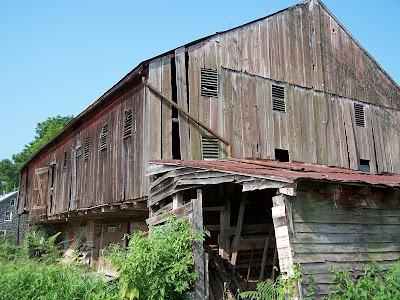
These are the original wooden planks that encompassed the barn in 1863. I really hope that all of these original fixtures remain intact as restoration continues. Over 100 Confederate prisoners were guarded in the wagon shed seen here on this side of the barn...not a very comfortable space for such a large amount of guys.

In my personal opinion, I think this would make a great satellite museum for the park. What better place could they interpret the care of the wounded in the aftermath of the battle? It could be largely furnished as it was back then and also have displays on Civil War medicine. Think of the living history opportunities possible out here. Time will tell. But nevertheless, this Gettysburg gem has been saved.


