Wednesday, October 21, 2009

150 Years Later...


Welcome to the new blog! This past weekend, the family and I embarked on a trip to Harpers Ferry, West Virginia to commemorate the 150th anniversary of abolitionist John Brown's raid on the town. This special event marks the kickoff to the Civil War Sesquicentennial. Despite less than ideal weather, it was an incredibly fascinating and informative two days. We saw and took part in many events. Check out our chronicles below.


We began our evening at the Kennedy Farm, five miles north of Harpers Ferry in Maryland. The log cabin was constructed by Dr. Robert F. Kennedy (no relation to the Massachusetts Kennedys) in 1852. The doctor died in early 1859 and the farm sat vacant for several months.


Brother Mark and I stand in our warm clothing in front of the Kennedy Farm. We feasted on hot apple cider and soup until the program was to begin. We also did some exploring.

John Cook, one of Brown's faithful followers, lived in Harpers Ferry for a year before the raid. He got to know the town and its people very well. When Brown arrived in nearby Sandy Hook, Maryland on July 3, 1859, he discovered this farm was available for rent and found it to be the suitable site for his base of operations.


This view looks west from the "Virginia Fence" of the Kennedy Farm front yard. The mountains in the background are hidden in the misty fog. The clouds of war looming perhaps?


Mark poses with John Brown and his son Owen in the dinning area of the Kennedy Farmhouse. From this room, "Old Osawatomie" and his followers planned their daring raid on Harpers Ferry. The house is completely furnished as it would have been in 1859.


We then ventured into the attic (or garret as they were known back then). Here, weapons, cots, utensils, and everyday items are shown. In this attic, some twenty raiders lived, ate, and slept during the humid summer of 1859. (Annie Brown noted they smelled here too.) They prepared for their mission in the cramped atmosphere for three months. During their frequent free time, they might have played cards or wrote letters as shown above.


Apparently one of the raiders still resides there. Here, I took a seat beside a waxy Shields Green. The twenty three year old man had escaped slavery from Charleston, South Carolina earlier in life. He was introduced to Brown by Frederick Douglass at the latter's home in Chambersburg, Pennsylvania. Green was among those who were sent to capture Colonel Lewis Washington, great grandnephew of George Washington, during the raid. Green was captured and was executed by the Commonwealth of Virginia on December 16, 1859. Douglass noted of Green: "Shields Green was not one to shrink from hardships or dangers. He was a man of few words, and his speech was singularly broken; but his courage and self-respect made him quite a dignified character."


The Kennedy Farm is a National Historic Landmark. It was purchased by Captain South Lynn nearly thirty years ago and has been meticulously restored to its mid-nineteenth century appearance. It has been family owned and operated every since as a private museum. Kudos to the Lynn Family!


A very cool look into the bedroom window of the Kennedy Farm.

video
One of the first speakers was Alice Keesey Mecoy, great great great granddaughter of John Brown, who recounted Annie Brown's role on the farm. On more than one occasion, Ms. Brown prevented detection of their plot by shewing curious neighbors away. The speakers spoke from the farmhouse's front porch. (Sorry. It was dark out.)


Among the speakers was Park Ranger David Fox of Harpers Ferry National Historical Park. They all read firsthand accounts by the raiders and their acquaintances. We embarked after these excerpts with Ranger Dennis Fry at eight o'clock, the exact same time Brown left the farm, 150 years to the hour. He used the same words of Brown as well: "Men, get on your arms. We shall proceed to the ferry."

Although you wouldn't be able to tell, hundreds of people are in this photo. You can see some of their flashlights, cell phones, and cameras in the darkness. We set out on the march, led by Frye on a horse drawn wagon. We proceeded down the Harpers Ferry Road into the pitch black darkness.


This map shows the route John Brown (and we) took to Harpers Ferry. Map by Steven Stanley. Courtesy of the Civil War Preservation Trust.


Some four miles later, we made one of our many tour stop at the remains of the former Chesapeake & Ohio Canal (seen at left). Dennis Frye, shown above in 1859 apparel and weaponry, was thrilled about the rather cold and drizzly weather. "It adds a sense of misery and foreboding," he told me beforehand. The raiders experienced very similar weather conditions exactly 150 years previously. A very accurate atmosphere and mood indeed. We followed the C&O Canal pathway for the final mile before we reached the town.


Once our group reached the Potomac River, we crossed the railroad bridge to the dimly lit town.


Here is a better view of the bridge in daylight taken from The Point. We crossed the more modern one at far left. Brown and his men crossed the late tin covered bridge at right. Only the stone foundations of it remain. Maryland Heights are shown in the far background.


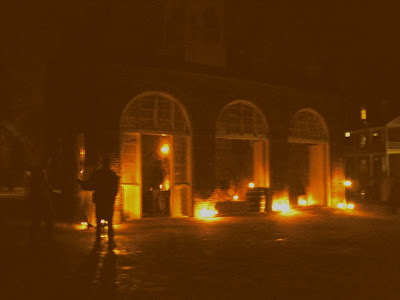
We then finally came upon the lantern lit engine house, the site of John Brown's last stand.


A look into the period furnished office of the engine house.


Over 300 people, wet and probably very tired, began to congregate around the structure for the solemn conclusion of our four hour program. At this point, twenty four people were given candles.


Mark, Dad, and I were among the twenty four people given a candle. Each candle represented one person who was killed as a result of the raid. Fred Morsell (aka Frederick Douglass) read each of their names. Each person came forward and lit their small candle on the much larger one resting on the barrel. We stood there until all the names were read.


Dennis Frye led us with candles behind the engine house. We gathered in a circle. He said he did not know why we were chosen to take part, but we were all chosen for a reason. Like each life that was extinguished, so then were our candles. The name on my candle was John Kagi.
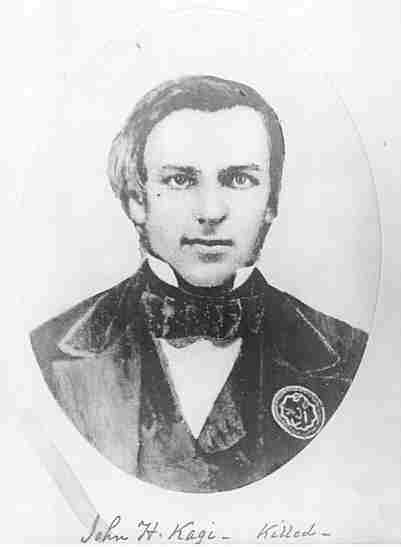

John Henry Kagi (March 15, 1835 - October 17, 1859) was second in command to Brown in during the raid. He bore the title of "Secretary of War" in Brown's "provisional government." At age 24, Kagi was killed on the second day of the raid.


We took part in further commemorations the next day on October 17. Active members of the United States Marine Corps were present and equipped as the 1859 Marines were. Nearly ninety Marines helped suppress Brown's raid. They were led by Robert E. Lee of the U.S. Cavalry.


Visitors gather at John Brown's Fort for "The Final Assault" program during the John Brown 150th commemoration. NPS photo by Jim Wassel.


"The Point" was the site of the Wager House Hotel in 1859. Over eighty years earlier, Thomas Jefferson wrote, "This scene is worth a voyage across the Atlantic." Here, the Shenandoah River on the right flows into the Potomac River on the left. Washington, D.C. is fifty one miles downstream. The river, arsenal, railroads, bridges, and canal made this a vital strategic position.


We once again joined my good friend David Fox for a two hour tour of John Brown's raid.

video

David tells us three of the main fears slaveholders had during the times of John Brown. The first was slave revolt, which Brown had hoped to initiate. (The popcorn popping sound is rain hitting my umbrella.)

video
A second fear was that of a violent abolitionist movement. For years, northerners had been preaching freedom and southerners feared words would be turned into action. John Brown did exactly this.

video
A third and final fear of white slave owners was simply being outnumbered. Planter elites wanted tax incentives for poorer white southerners to afford slaves. Such a strategy would create harmony between rich and poor planters throughout the south. The idea was never put into practice.

video
In our final video, David describes the final moments of the assault on John Brown in the engine house. We and the Marines are standing inside the fort itself.


Finally, here is an excellent documentary on the raid via YouTube.

I will have more information on John Brown's raid in the coming days. Stay tuned! Special thanks to Dennis Frye, David Fox, Dr. Sandra Petrulionis, and my family for all their help and expertise!


Monday, October 19, 2009

A Summer in Retrospect


The March. Pictured left to right: Intern Rich Smith, Ranger Scott Hartwig, Ranger Glenn Knight, me (in my Berdan Green uniform), Ranger Matt Atkinson, Ranger Bob Hall, Ranger Dan Welch, Intern Kristen Campbell, and Intern Chris Brusatte. What a company!

The summer season of 2009 will be one which I will never forget. My three months living on the Gettysburg Battlefield offered new challenges and adventures every day. The events of the summer had so many positive impacts that I know I won't be able to recount them all.

I did not only learn more about the Battle of Gettysburg and American History on a daily basis, but I learned how to be a better presenter, how to more effectively interpret the history of our nation to people of all ages and backgrounds. I had firsthand access to one of the finest collections of Civil War books, records, photos, and primary resources in the country. Through this bounty of historical material, I was able to conduct further research for my programs and even discovered more about my own ancestors who fought in that war.

On one of my first days working the front desk at the visitor center, a middle-aged family man approached me at the desk. He was from New Hampshire. He told me he believed he had an ancestor who died in the battle and was buried there, but was never sure if it was anything more than family legend. "What was his name," I asked him. After he told me, I pulled out one of the mammoth record books kept behind the desks to search for the soldier's name. I found it. The man almost fell over. I then pulled out a map of the National Cemtery and showed him where his long lost ancestor was buried. The man was ecstatic. He told me he was going to rush back to his camper and tell his eighty-eight year old grandmother (confined to a wheelchair) and tell her he finally found her great, great uncle. Inside, I was equally enthused. I felt good. I made a difference to a man and his family. It was moments like that which really made the summer worthwhile.

I experienced an equally gratifying moment one July day when I was informally talking with visitors at the Copse of Trees near the Angle. A family of five told me it was their first time to the battlefield. They wanted to know all about the monuments along the stonewall. When I reached the 20th Massachusetts Monument, I told them the touching story of its origins. Atop the monument's rather short pedestal sits a massive pudding stone rock weighing several tons. It once sat in a town park where many of the soldiers in that regiment played in their youth. It came to represent the same youth lost in the great battle. "The rock was taken from a park in West Tisbury, Massachusetts," I noted. The family gave a collective gasp. "We are from West Tisbury," the father shook his head in amazement. For that family, they were able to make a connection to the Gettysburg Battlefield which may not have otherwise happened.

If there is one thing I learned over the summer, it was that the place represents different things to different people. A grown man, a first time visitor, began to openly weep in front of me and his own family after I had described what had occurred in the lush fields before us. To a child on one of the children programs I helped with came a desire to learn more, a youthful exuberance to explore and appreciate. The stories go on and on.

During the first weeks of training, Supervisory Historian Scott Hartwig led us interns and new rangers on a three mile hike from the Slyder Farm at the base of Big Round Top, up Little Round Top, up Cemetery Ridge, and back to the visitor center...all in period Civil War gear. A half dozen photos with tourists and several miles later, we feasted heartily at the visitor center that evening. Our feet were killing us, but hey, we got one good glimpse into Civil War life. That's what we were out to do.


Filmmaker Ken Burns, the illustrious James Jones, and myself.

I also had the opportunity to meet countless historians and public figures in addition to conversing with thousands of visitors. I met nationally renowned historians like Bill Frassanitto, Gabor Boritt, and Drew Faust, filmmakers Ken Burns and Ron Maxwell, and even actor James Earl Jones! Not to mention all the great people with the National Park Service, Gettysburg Foundation, and Licensed Battlefield Guides. And those are just to name a few!

I kept a daily journal of my adventures and misadventures throughout Gettysburg. And there are some very colorful stories indeed. Each visitor has a story to share. Perhaps I will write a book...

This will be my final full posting on Interning Learning, for I have finally run out of material to share from the summer. A new, but similar blog will be initiated in the coming days. Stay tuned.

My summer in Gettysburg was unforgettable. As I said earlier, it was something which cannot be fully recounted in one article. If anything, the summer gave me an even finer appreciation of Gettysburg's rich history and the incredible events which have taken place there. Thank you to all who shared an interest and passion in my spectacular summer.


Chris, Rich, and I pose for the photo of the summer. Taken at the Victorian Photo Studio in Gettysburg by Del Hilbert.

Sunday, October 4, 2009

Tips for Prospective Interns


I have already received many emails from fellow college students who share my love of history. Their questions are all the same: How do I get an internship at Gettysburg? Well, here are some tips which you may find of use.

I would begin by typing up a resume. Throw in everything of note you have ever achieved during and since High School. Also, get involved with local historical societies, museums, and non-profit groups in your area. The park is looking for people who have some experience in the field of history, especially young people who have given tours/presentations at other sites. For instance, I volunteered at a National Park and my county historical society. These are the best credentials you can have. I didn't include a reference letter written by a professor or anything, but it can't hurt. I did however include a reference list with names and contact info of people I previously worked with (either professional or volunteering). Also include any projects or papers you have completed regarding history. The more you include the better. Volunteer. Volunteer!

The internship itself is fantastic. You would be required to perform a number of tasks during the course of the summer. They usually include: two battle tours/presentations (usually of your choice from a list of available programs), aid with the "Join the Army" Children's Programs, education carts (hands on stuff with kids) through the museum halls, informal battlefield "roves," working the front desk, research projects, and helping rangers with other programs if needed.

Male interns live in an old brick farmhouse right near Culp's Hill and it's only a five minute walk from the visitor center. It's a very convenient location.

The internship is most definitely worth it! You will learn so much. In addition, you may get school credits for it. I got 4 History credits for mine.

I believe applications were due in late November. So, I'd get your materials in by the end of October at the very latest. The sooner you get the stuff in the better. It shows commitment on your part, and the deciders notice that. Therefore, I'd get started your resume and quickly get involved in historical groups if you aren't already.

Getting to know some rangers helps as well. Tell them why you are interested and kindly ask for some more information. This is a good way to get your foot in the door. They will take more notice of your resume because of the personal connection they already have with you. If you are in Gettysburg before that time, feel free to talk to a ranger and ask questions. Go on some programs to get a feel for what you might be doing. They'd be happy to answer your questions. Below is the information form that Education Specialist Barb Sanders sent me a year ago when I was expressing interest. Her email address can be found here.

The Summer Internship Program
Gettysburg National Military Park

Are you interested in a career with the National Park Service? Do you enjoy talking to people from across the country and around the world? Would you like to share your interest in history and help others enjoy the stories of this park? Gettysburg NMP offers internships to motivated, enthusiastic individuals who seek to share their talents and gain valuable work experience.

We want you to enjoy your internship and be successful. Interns receive up to 40 hours of formal training as well as on-the-job training as part of their internship. Training is in subjects such as, meeting/greeting the public; operating visitor facilities, organizing and presenting effective interpretive talks, interpretive techniques, and radio/safety procedures.

A typical internship in the Division of Interpretation at Gettysburg NMP consists of three things. Interns help staff the information desk at our two visitor contact facilities. This offers experience in meeting and greeting the public, providing information/orientation to the park and area, as well as an understanding of what it is visitors seek in a visit to the park. Interns are also responsible for researching, preparing and presenting two different interpretive programs, one relating to the Battle of Gettysburg, and the other dealing with the themes evoked by the National Cemetery and President Lincoln’s Gettysburg Address.

Internships are typically offered in the summer months when the park is busiest, but occasionally the park can provide internship opportunities in the Fall and Spring. A typical internship lasts 10-12 weeks. Interns work 40 hours each week, and weekend work can be expected. Positions are unpaid, although the park provides free housing and a cost of living stipend.

Our interns are in public contact positions and therefore are required to wear a uniform (usually khaki pants and a dark blue shirt). Currently we provide a uniform allowance to cover this cost.

To apply for an internship at Gettysburg NMP you should submit a resume and cover letter. Your resume should include your name, address, telephone number, the names of any colleges or universities attended, and a brief synopsis of your work experience. Your cover letter should address why you want an internship at Gettysburg NMP, and what you hope to gain from it.

Good luck to all you students of History out there!