
 What connects people to history?
Book Review
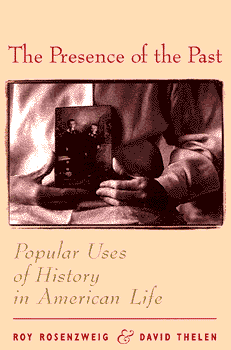
Roy Rosenzweig and David Thelen’s The Presence of the Past arose from a multi-year study to discover how history is perceived and used by the common American. The authors refer to certain views of the past as “paradoxical” due to the dual traits history holds in the national consciousness (3). There is a common perception among many that the contemporary average citizen is largely historically illiterate. Yet, at the same time, interests in public history, heritage tourism, media, and popular culture are growing. To better comprehend this phenomenon, the authors set out to understand such patterns via telephone interviews with over one thousand everyday citizens. Through these phone questionnaires, they made it plainly evident that people take the past personally. They learn of, visualize, and appreciate it best when conveyed to them by a loved one or friend. For such interviewees, the past was relevant, central, and vital to the family social sphere – a staple of their very being. Their pasts were far from dead.
The investigators discovered further detail regarding these facts and elaborated on their circumstances throughout. Of the 1,453 interviewed, the vast majority where able to connect with the past due to familial or even individual experiences (12). It is with this past which many feel most comfortable. Because this history is told often in the first-person, it is a past much easier to connect with and interpret. Many of these same individuals use the past as a blueprint to their own futures. Narratives such as these are considered most important not only in determining where we have been but where we are collectively going as a society.
While the seeming majority feel closest to the past when connecting with a person who witnessed or survived the actual events, they also trust (or distrust) a variety of other source materials available to them. The interviewees considered museums especially factual and unbiased in presenting the past. Artifacts displayed in such exhibits particularly seemed to reveal human traits of previous times effectively well. Personal accounts of historic events (including those offered by family) in addition to the knowledge displayed by college history professors, also received high marks in the credibility ratings. That said, high school history teachers received less support for a variety of reasons. Predominantly, those questioned defined their former classes as dull, irrelevant, and repetitive due to the fact that they did nothing more than memorize glorified national history and were forced to regurgitate numb facts and key dates. Often, there is no engagement or contextualization in such environments. Such patterns have been a recurring problem in the classroom. Furthermore, despite the long-standing belief that many learn their small traces of historical knowledge from movies, the larger portion of those interviewed displayed their mistrust in history portrayed by Hollywood. Like other special interests, they claimed, film producers too have an agenda in how the past is depicted on the big or small screens.
As Rosenzweig, Thelen, and their colleagues discovered, those surveyed did not altogether reject key tenets of America’s collective past but only certain aspects which reinforced the greatness or predominance of nation-centered stories (Consensus History). Rather than fall prey to old-school interpretations, citizens construct their own interpretations of the past through personalization and the use of cultural identity as a bridge to both the past and future. This is especially true of the African Americans and Native Americans who were interviewed. With these minorities, there is a recurring pattern of mistrusting authority, traditional historical views, and closely embracing what many of them referred to as “our” history or culture. In addition, such ethnic groups might claim an even greater historical (or spiritual) bond to sites of strong symbolic and historic significance to their respective cultures. While many white tourists visit historical attractions leisurely or serendipitously, blacks and natives embark on intentional pilgrimages to places of heritage importance. This may be the case because those sites not only depict oppression, racism, and pain, but also the subsequent triumphs over those obstacles as well as symbols and hopes for the future.
The subjects studied throughout this survey are feasibly as well-rounded as possible. Composed of numerous racial, economical, and geographical sects of society, the historians supervising this project gathered data somewhat segregated but yet as all-inclusive as was humanly attainable. Through these vivid scores of pervasive and often emotional accounts, the authors reveal that history truly is most frequently felt and conveyed successfully not through textbooks or nonfiction, but through deeply personal connections to places, items, and people closest to them.


