Sunday, May 29, 2011

Victorian America in the Civil War


Rose, Anne C. Victorian America and the Civil War. New York: Cambridge University Press, 1992. 324 pp. $31.99 – ISBN 0521478839. Book review by Jared Frederick.

Anne C. Rose’s Victorian American and the Civil War delves into the lives, business, and perceptions of seventy-five middle class Americans against the backdrop of the conflict that altered all their lives. Of these, most are northerners who were or shortly thereafter became prominent members of their community or generation. These personalities include Ulysses Grant, William T. Sherman, George Templeton Strong, and Varina Davis. At the center of Rose’s argument is the idea that the Civil War further established rather than dismantled romanticized Victorian sensibilities. The nature of the war also led to a reexamination of religious matters and dependence. In some cases, the bloody struggle weakened faith to the point that many citizens turned to other social outlets to seek comfort or guidance. Furthermore, this growing apathy or ambivalence toward religion, she argues, helped lead to the societal disparities and strife of the subsequent Gilded Age.

Divided into sections regarding religion, work, leisure, family, and politics, Rose’s study attempts to interpret a wide range of social factors which forced Civil War Americans not only who they were, but what they desired to be. Of these topics, religion is the one the author tries to understand the most. Although religious beliefs helped fuel the war, the drawn out nature of the war helped lead to a “crisis in faith and nationhood” where citizens reconsidered the power of a benevolent God as well as their place within their own country. Religious communities of the era, Rose argues, increasingly lacked fellowship, questioned the meanings of life, and struggled to reconcile mass death with their core religious and moral beliefs. As a result, they turned their attention to secular activities and jobs where satisfaction could be attained. In this light, religion no longer provided the spiritual nourishment it had in previous decades.

As the war bolstered the power of the Federal Government, Rose sees the alignment of politics and romanticized Victorian notions within the same public trend. Here, work and leisure activities came to embody one’s self more than religion had. War reunions, veterans’ groups, and war-related organizations allowed people to have structured, sophisticated, and even prominent positions in society. If business proved not to be rewarding enough for these citizens, leisure activities served as a “cushion” for their shortcomings. Politics served a similar function in the fact that it, in some ways, became a religion in the fact that it became the public forum in which to discuss morality, ideological issues, life goals, and daily life. In stating this, Rose reaffirms that the Civil War could partially be measured as a quest of giving meaning to life in addition to establishing social identity. In doing so, the war became “a defining event, an experience like a religious conversion that would follow human beings to come to terms with themselves.” The conflict served as “a vehicle of spiritual revolution that face it such a central places in their lives” (236).

Also significant, Rose claims that the most crucial of social and intellectual trends of the era already had a tight grip on society before the war even took place and the conflict did not greatly alter these already entrenched ideologies. She states that, “[r]eligious disaffection was challenging the availability of belief that had anchored culture in earlier decades. . . . The war encouraged bureaucratic organization, personal autonomy, and the expansion of experimental mental and sentimental forms of reference. But it did not cause the central dilemma of the Victorians to be redefined” (13). In other words, she places people within a societal shift already taking place rather than a shift created entirely by the war. She notes in a rather contradictory way that the struggle did, however, allow them to “reassess the value of human effort.”

Despite Rose claiming that Civil War Americans were living and working within and existing framework, she goes on to note that the conflict strengthened family kinship and reinforced sentimentality. Rose argues that this kinship increased their interests in government. With this, she concludes that politics replaced religion in a variety of ways because it served to satisfy social, intellectual, and moral convictions as a means of weighing and judging themselves (224).

Monday, May 16, 2011

Rock n' Roots at Sun Studio


Some time ago, the family and I had the opportunity to travel to the wonderful State of Tennessee - especially the Memphis area. Beside visiting Civil War battlefields and sites associated with the Civil Rights movement, we also had the opportunity to explore some very cool sites related to the early days of Rock and Roll, including the Historic Sun Studio on 706 Union Avenue in Memphis. Several of the greats had their beginning in this humble studio, and we shall explore some of their stories here - including "The King."


Sun Studio was established in January 1950 music producer Sam Phillips. In earlier days, Phillips recorded the music of several prominent African American musicians, including Howlin' Wolf. However, there was a relatively small audience of whites for what was then considered solely black music. Though always promoting his musicians, Phillips strove to discover a white singer that could replicate the likes of Howlin' Wolf in order to make the music marketable to the masses. That man stepped through the studio's doors in August 1953 - a young kid from Tupelo, Mississippi named Elvis Presley. The future star didn't meet success until July 5, 1954 when he sang a rendition of "That's All Right." The song became an overnight sensation and the rest is, well . . . history.


Part of the studio is filled with original and reproduction posters and ads promoting Sun's various artists throughout the 1950s.


Jerry Lee Lewis too came to Sun Studios a relatively unknown musician in 1956. He did several songs for the company over the course of several years but is by far best known for "Great Balls of Fire" recorded and played on this piano on October 8, 1957. Some of Lewis' records are on display above the piano on which he crafted his hit songs.


Sun Studio closed in 1968 but reopened nineteen years later as a working studio and museum. Plenty of guitars, pianos, and other instruments were taking a rest the day we visited. Phillips was inducted into the Rock and Roll Hall of Fame in 1986 for his achievements attained while running this studio.


Sam Phillips' secretary, Marion Keisker, greeted many artists as they came to audition for songs in this front office looking into the heart of the studio. In some ways, she should be the one given credit for snagging Elvis and launching his career. Following his first audition, she wrote on his file: "Good ballad singer. Hold." Indeed!


Naturally, what is a visit to Sun Studio without posing with the same microphone Elvis and many other greats recorded their first songs with? Luckily for you, there is no audio of me singing.


Perhaps the most historic event in the studio's history was an informal jam session on December 4, 1956 in which (left to right) Jerry Lee Lewis, Carl Perkins (who recorded "Blue Suede Shoes" there in 1955), Elvis Presley, and Johnny Cash. This session was recorded and later released as Million Dollar Quartet. What an evening that must have been!


Of course, I can't show you all these photos and then not play a Sun Record for you. Enjoy!

Wednesday, May 11, 2011

The History Channel Presents "Gettysburg"

A new documentary by the Scott Brothers

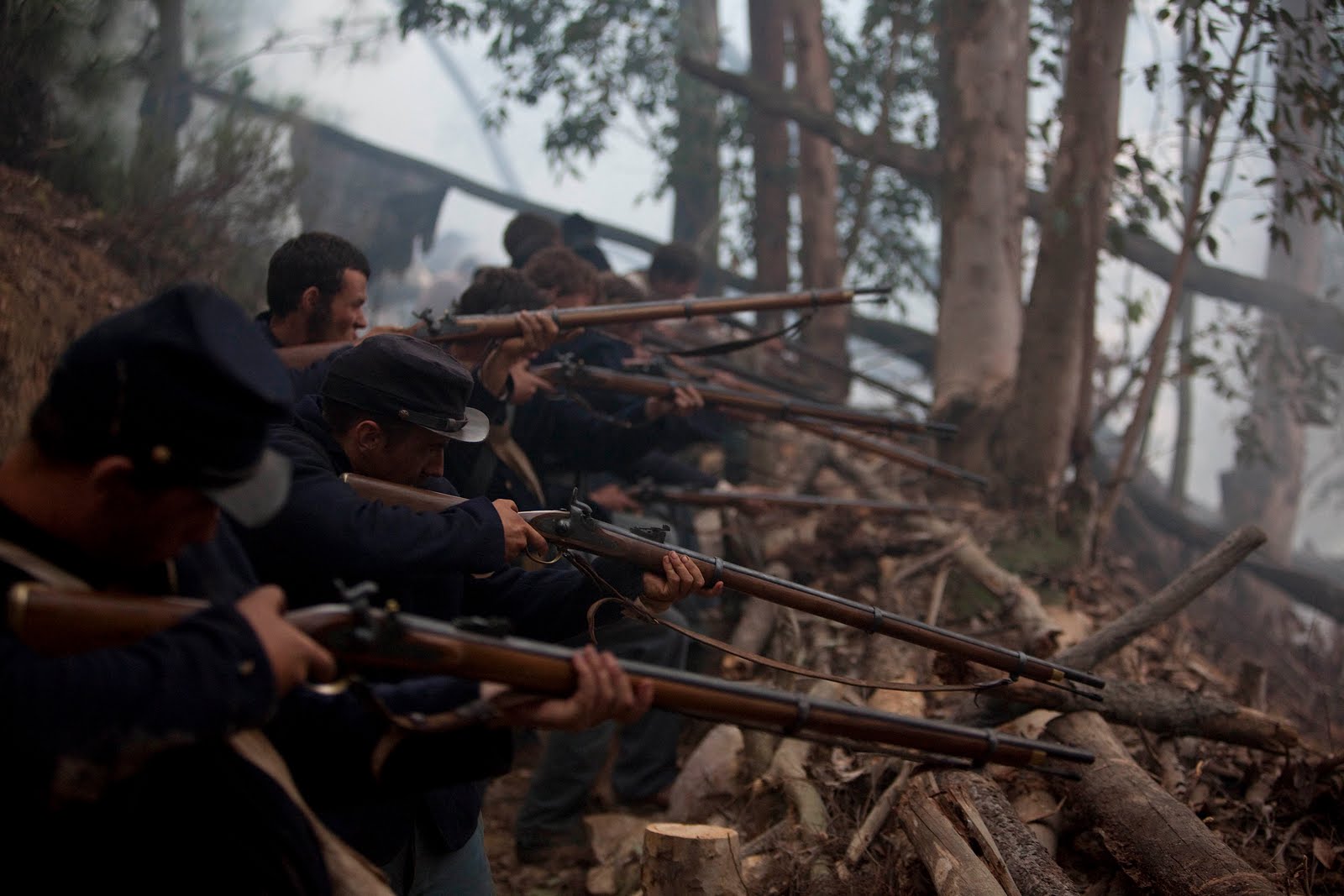
A film still from Gettysburg which depicts Culp's Hill.

The good folks at History were kind enough to send me some promotional materials regarding their upcoming documentary Gettysburg - a two hour film narrated by actor Sam Rockwell that adds some cinematic flair to the battle's interpretation - though I hope in an accurate and realistic fashion. The film's press statement notes:

"Gettysburg kicks off a week of History programming commemorating the 150th anniversary of the Civil War. Executive produced by Ridley and Tony Scott, this special strips away the romanticized veneer of the Civil War. It presents the pivotal battle of Gettysburg in a new light: as a visceral, terrifying and deeply personal experience, fought by men with everything on the line. Compelling CGI and powerful action footage place viewers in the midst of the fighting, delivering both an emotional cinematic experience and an information packed look at the turning points, strategic decisions, technology and little known facts surrounding the greatest engagement ever fought on American soil.

The special begins in the high stakes summer of 1863, as the Confederate Army of Northern Virginia crosses into Pennsylvania. Trailed by the Union's Army of the Potomac, Lee's 75,000 strong army heads towards Harrisburg, converging instead near a quiet farm town, Gettysburg. Known then only as a crossroads where ten roads running in all directions converge like a wagon wheel, this small town would become site of an epic battle between North and South. For three days, each side fought there for their vision of what America should be.

In collaboration with highly esteemed Civil War historians, History combed through hundreds of individual accounts of the battle to find the unique voices of struggle, defeat and triumph that tell the larger story of a bitterly conflicted nation."

I am glad to see the History Channel returning to its roots in some degrees. I long for the days when Civil War Journal, Civil War Combat, Wild West Tech and related quality documentary programs were a staple of the History Channel's regular programming. Gettysburg is certainly a step in the right direction as the nation begins to commemorate the conflict's sesquicentennial. Knowing dozens of Gettysburg historians, I will be anxious to see their reactions as well as those of visitors as I begin another summer as a seasonal ranger at Gettysburg. Furthermore, I remain hopeful that such programming will pique the interests of general viewers and encourage them to further explore and visit the sites associated with this pivotal event.


Gettysburg premiers on History on May 30 at 9 p.m. EST. I will be tuned in. Also keep an eye out for my review of the film following its premier. Thanks again to History for sending me information and photos about their documentary. I hope similar programming will be coming to our television screens throughout the 150th anniversary.


A nice shot of Confederate artilleryman with their mud-caked gun. I'll be interested to see how artillery is represented in this film - especially the 300 cannon duel of July 3.


A photo of what I assume to be the famous Iron Brigade at night on Culp's Hill. The press release suggests that much of the film's commentary was taken directly from personal accounts. This too will be interesting in seeing which soldiers and officers are depicted.


I am going to estimate that these are Confederate troops scaling the fence along the Emmitsburg Road during Longstreet's Assault. I am willing to overlook the inaccurate Confederate flag (this one was not used by Lee's Army of Northern Virginia) if the film draws people to the battlefield and nurtures an interest in the past. Still, going by the documentary's trailer, the visual effects and cinematography look impressive. I, for one, will be tuned in on May 30th with anticipation of the end product. Hope you will too!