"All politics is local," Speaker of the House Tip O'Neill once noted. Historian and writer Adam Goodheart, author of 1861: The Civil War Awakening, concluded that the same should be said of history. I recently had the opportunity to speak with Goodheart following his lecture at the American Association for State and Local History Conference in Richmond. The basis for his book has origins in a field trip with his students to Poplar Grove Plantation - an abandoned 250 year old manor house in the back country of Maryland near Chestertown. There, one of his students discovered a bundle of letters describing the national turmoil and inner debates Americans felt regarding secession, Union, treason, loyalty, and uncertainties. One Virginia colonel who was considering the merits of secession weighed the risks of become a Founding Father in a new revolution or being branded a traitor in an illegal rebellion. "It is like a great game of chance," his wife reflected. In times of war, citizens reflect not only on what can be gained but what can also be lost.
In order to understand the past, Goodheart argues, one has to travel to it. As he drives his students down the long gravel path to the desolate Poplar Grove he exclaims, "Fasten your seat belts. We are now leaving the 21st Century!" Few things in the study of history can compete against "the eloquence of place." It is in such locations that one can best relate and connect with the compelling human drama of the era. The conflict was more than a movement of politics, tactics, and mass columns of troops. It was a war of "millions of individual hearts and minds." Each of those individuals are pieces of the larger historical puzzle illustrating the times in which they lived and died.
When recalling his middle school field trip to Gettysburg National Military Park, he noted how the Electric Map was "never a history that appealed to me." He continued that such methods of "treating the Civil War like a great Super Bowl contest" in some ways diminishes their individuality and human traits, not to mention their reasons for fighting. In many instances, Civil War soldiers, "treated schematically, marching mathematically in step to ideological beats" oversimplifies the men and their respective causes. Contrary to Thoreau's famous quotation, "Simplify, simplify," Goodheart contends the historian should "Complicate, complicate." Stir the hornet's nest. Cause people to rethink, reanalyze, and further appreciate the history they thought they knew.
Drawing contemporary parallels to the past is an effective measure of allowing comprehension to important or tumultuous events. Events such as 9/11 change our perceptions of what had been as well as our expectations of what to was come. The author claims that Fort Sumter was that "9/11 moment" to the Civil War generation. On the rooftops of Charleston, South Carolina in the early morning hours of April 12, 1861, commoners watched the ensuing devastation and wept much like New Yorkers watching the Twin Towers 140 years later on 9/11. Both were pivotal moments that reshaped how people perceived their lives and their world. There was no going back - and they knew it.
Goodheart concluded by sharing a story regarding Secretary of State William Seward, revealing what Fort Sumter truly initiated and represented to the nation:
"When Lincoln finally unveiled the Emancipation Proclamation in the fall of 1862, he framed it in Butleresque terms, not as a humanitarian gesture but as a stratagem of war. On the September day of Lincoln’s edict, a Union colonel ran into William Seward, the president’s canny secretary of state, on the street in Washington and took the opportunity to congratulate him on the administration’s epochal act.
"Seward snorted. 'Yes,' he said, 'we have let off a puff of wind over an accomplished fact.'
“'What do you mean, Mr. Seward?' the officer asked.
"'I mean,' the secretary replied, 'that the Emancipation Proclamation was uttered in the first gun fired at Sumter, and we have been the last to hear it.'"
The Dedication of 9/11's Flight 93 National Memorial
On the anniversary of one of the most tumultuous days in American History, I traversed with three colleagues to the open fields outside of Shanksville, Pennsylvania to partake in the dedication of the Flight 93 National Memorial. Such scenes as above were easily found amongst the tens of thousands who were present. People from all walks of life were present - some in uniform, many sporting patriotic apparel, others in formal suits and dresses, citizens from across the nation and the world. I came across a gentleman from Germany who was wearing a t-shirt exclaiming "Obama got Osama." The importance and heartfelt connection to this site exceeds the confines of this country because people worldwide could relate to the loss in numerous ways. Loss, and gratitude above all, were the major emotions evoked this day.
I was never truly able to visualize or relate to the Flight 93 tragedy until I viewed the 2006 film United 93. Following the events of this aspect of 9/11 in real time, director Paul Greengrass was meticulous in his research of the film and based much of the script from flight and air traffic control audio in addition to phone calls made from the plane. Though it is still a movie, it placed viewers in the front seat of the plane and required them to reflect on how they may have reacted in the situation depicted. It surely made me think. I must warn you, the scene shown above is violent and desperate - and it gets the point across in doing so.
We arrived two hours early on September 10 (as the NPS website instructed us) but, as we expected, thousands of cars were backed up in the mile leading to the park entrance and then the distance of the lengthy park road itself. This scene created slight frustration and even some humor. Eventually, the crowds decided on their own initiative to open both lanes of traffic to head to the proceedings. However, the jam was oddly enough also inspiring. Looking at the state license plates we saw Arizona, Illinois, Delaware, Virginia, and many more. Ordinary citizens traveled hundreds, even thousands of miles to participate in an event all knew would be historic. The only downside: folks were parked everywhere. Come Monday morning, portions of the park landscape will closer resemble Woodstock 1969 than a national memorial. Oh well, it's all for the greater good I suppose.
After finding a parking spot, we still had a decent trek to make before we arrived at the shuttle bus area. Here too we came across visitors of very diverse backgrounds. Many small children walking with their parents (this one in the Navy) waved American flags on the roadside. Biker groups rode through with 9/11 emblems stitched onto their sleeveless leather jackets. It is rare when one has the opportunity to see such a wide and diverse array of humanity.
After catching a bus, we found ourselves in another line: a security checkpoint. As one can imagine, protection was thorough. This line too can be considered a legacy of September 11. The senses of fear, anxiety, and protection which arose from 9/11 undoubtedly still reside within our collective psyche. Metal detectors, armed guards, and recon teams reminded me of this evident fact. But attendees and employees alike were understandably cooperative and courteous with each other. Visitors gave out their extra bottles of water to fellow attendees whom they had never met. Others gave spare batteries to those who's cameras had died. Where courtesy and patience sometimes lacked in the automobile line, it was overly abundant in this one.
Many spent their time in line by viewing the several wayside markers on display in the waiting area. This one features profiles of the passengers of Flight 93 (minus the four hijackers). A women in line in front of us kissed the second from right top corner photo and said, "Miss you."
After we were cleared, we at last made it to the main staging area. Tens of thousands of attendees had gotten there before us. We managed nevertheless to work our way in a little bit closer. The first phase of the memorial stands to our left, out of shot. The future $10 million visitor center will be built atop the hill in the far background. President Clinton and Speaker of the House John Boehner are going to hold a bipartisan fundraising event to complete this task.
A multitude of VIPs were present to deliver remarks for the dedication ceremony. Left to right in the front row are George W. Bush, Laura Bush, Bill Clinton, Jill Biden, and Joe Biden. Among those in the back row are Secretary of Interior Ken Salazar, Families of Flight 93 President Gordon Felt, and National Park Service Director Jonathan Jarvis. President Obama will be visiting on September 11 itself.
I enjoyed all speeches equally, albeit for different reasons. Former President George W. Bush was extremely quiet, solemn, and seemed still burdened from his time in office but was applauded the loudest of any speaker. He recounted very personal stories from many of the families and victims. He alluded several times to the Civil War, noting that 9/11 was the bloodiest day on American soil since the Battle of Antietam. He spoke of the Gettysburg Address, which dedicated a not entirely different memorial slightly over 100 miles to the east.
Former President Bill Clinton too gave a very heartfelt speech and drew a historical parallel to the battle for the Alamo. He noted that it takes great dedication to risk your life but it takes exceptional courage to fight and know you are going to die. Such was the case for these respective incidents in 1836 and 2001. However, Clinton concluded, the victims of Flight 93 were not combatants. They were ordinary citizens who made a desperate decision with little or no time to act. That, he said, is why we were all gathered on the spot of their final demise.
Following a reading by poet Robert Pinsky, he read aloud the names of the forty victims. Each name was followed by two bell chimes. I hope this video can also capture some of the scale of the crowd as well as the layout of the site. One poem Pinsky read was "Incantation" by Czeslaw Milosz, which notes:
"As late as yesterday Nature celebrated their birth,
The news was brought to the mountains by a unicorn and an echo.
Their friendship will be glorious, their time has no limit.
Their enemies have delivered themselves to destruction."
Park rangers of all sorts and from all places were present. Interpreters, administrators, law enforcers, and PR specialists were all over. Even mounted U. S. Park Police from Washington, D.C. were present, seen here overlooking the ceremony from the nearby hillside. I saw familiar ranger faces from Allegheny Portage Railroad, Johnstown Flood, Gettysburg, and others. It is always reassuring to see multiple National Parks help others when they are in need of assistance for important event such as these.
But as you can imagine, there were more reporters than rangers present. We could see satellite vans for most of the major news networks and even more for more local broadcasters. Given the heavy presence of the press, I wondered how this commemoration may have differed from the 1951 anniversary of Pearl Harbor or the 1964 anniversary of the Normandy landings. What does this recently introduced twenty-four hour cable news cycle do altering the ways we remember history? Does the recent past become embellished or capitalized in a very tech savvy society? How might 9/11 differ in the memory of citizens 140 years from now versus today? Maybe I'll know someday.
Shortly following President Clinton's speech, the cluster of dignitaries exited the stage area and walked over to the white memorial wall seen in the far distance. In this particular photo, we can see park rangers removing the veil and exhibiting the memorial to the public for the first time. On each tablet is engraved the name of one of the forty passengers. The U. S. Navy Band played "America the Beautiful" in the background. This memorial has undergone, what I consider, unfair and exaggerated criticism in recent years. But in personally being there, I don't see how many could be angered. The monument is sleek, simple in appearance, and unobtrusive on the landscape - preserving the serene environment which will now always exist there.
Vice President Joe Biden (far right) gave perhaps the most impassioned speech. He referred to the crew and passengers as the first strike on the war on terror. My favorite portion is when he stated the wonderful Maya Angelou quote, "History, despite its wrenching pain, cannot be unlived, however, if faced with courage, need not be lived again." But is it true?
Musician Sarah McLachlan performed her songs "I Will Remember You" and "In the Arms of an Angel" - two customary prom favorites that worked surprisingly well for the day's commemorations. The national flags of Puerto Rico, Germany, Japan, and Australia seen in the background were in memory of the passengers on board who were of foreign citizenship. Following the last song, the American flag was retired by a park ranger honor guard. Father Daniel Coughlin (2001 Congressional Chaplain) and NPS Director Jon Jarvis respectively delivered benediction and dismissal.
As the crowds began to disperse, people began conversing with ceremony participants, families of the victims, and numerous dignitaries. A number of the pilots' United Airlines colleagues were in attendance and were interviewed by the press near us. The pilot seen here could have easily been on United 93 had the simplest of schedule revisions been made. This is a situation that many pilots have admittedly considered. "It could have been me."
Beyond the viewing platform of the memorial sits a lone boulder in the open field near the Hemlock Grove were United 93 crashed. Shortly after the crash, the local coroner ordered that the impact crater be backfilled. Thus, the rock not only marks the crash location but it also denotes the final resting place of the passengers and crew. At this time, only the family of those on board are permitted to enter the pasture. A pot of yellow flowers rested on top of it.
The memorial is, in many ways, reminiscent of the Vietnam Memorial in Washington, D.C. It's black walls and sleek design will eventually be incorporated in the yet to be completed semi-circular design entitled "Crescent of Embrace." The white panels with the victim's names are seen in the far center background. The families had thirty minutes of personal time at the wall before it was opened to the general public.
So what is next for the Flight 93 National Memorial? Naturally, the monument will be completed in the near future. But what about the visitor and education center to be built on the hillside seen above? I, for one, would like the center not only to be a living memorial to the courageous passengers who fought back, but I also want to know why 9/11 happened and what it has meant to the nation since. In a similar situation, I think we not only need to understand the beneficial legacies of Martin Luther King, Jr. at the National Civil Rights Museum but must also comprehend the hate, politics, and circumstances that lead to his assassination. This, the Civil Rights Museum has done admirably, but not without dispute. Regardless, to not fully understand the skewed mentality and world of the terrorists is to not fully appreciate what the victims of Flight 93 did. The complete story needs telling. I hope the Park Service makes the right move once the visitor center is in the works.
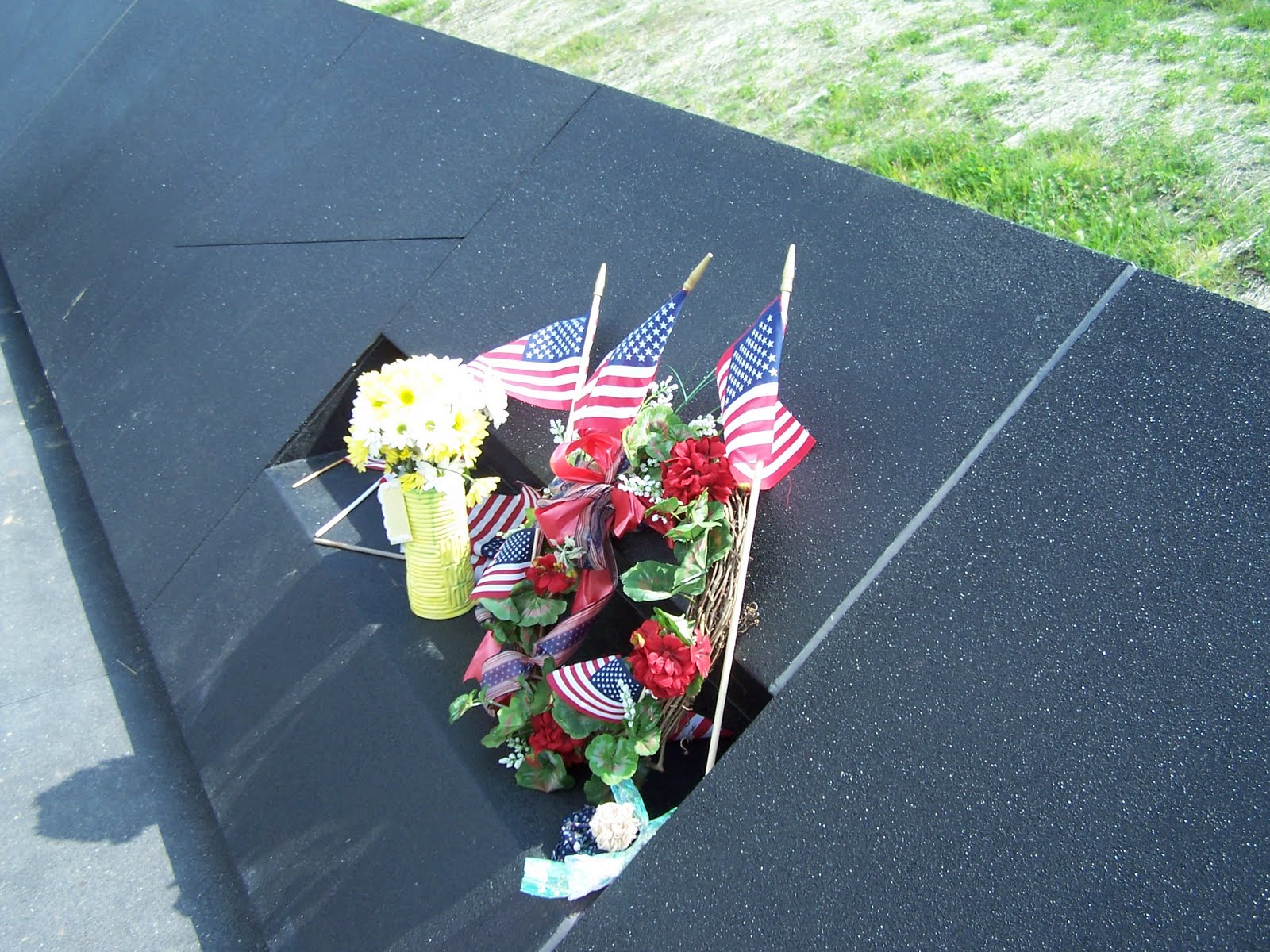
Also much like the Vietnam Memorial, multitudes of mementos, gifts, and flowers are left daily at the site. The wall even features occasional "shelves" visitors may leave these tokens of affection on. The black stone is cleaned weekly and all objects are collected for the park's archives and posterity. This is what the National Parks are all about: the preservation of place, objects, and collective memory. I'm glad that the final resting place of the Flight 93 victims is now included in this wonderful system. I'm glad I was there for this inclusion. I hope someday you can too.
19,000. 1,800. 50,000,000. What do numbers mean anyway? I for one always hated math or anything having to do with numbers. (This was yet another good reason to become a historian.) However, after reading Stephanie Smallwood's Saltwater Slavery: A Middle Passage from Africa to American Diaspora, I have come to more fully realize the importance numbers can have in illustrating historic events and their significances. The numbers above? American deaths in the Battle of the Bulge, deaths in Hurricane Katrina, and fatalities resulting from the 1918 Spanish Influenza epidemic, respectively. What can they tell us beyond, "Wow, those are big numbers"?
In a study that chronicles the tumultuous and heart-rendering tale of the 300,000 plus Africans who were transported from the Gold Coast in chains, Smallwood's book uses numbers to surprisingly illustrate the deeply human tragedy of the African slave trade. She notes, "By tallying the dead to measure the toll the voyage took on African life, we have made that body count the most potent symbolic measure of the horrors of the middle passage" (132). This goes back to reveal yet again that history is not the memorization of dates and the recording of data. It is the story of people. And numbers can illustrate that.
Numbers are thrown around sometimes loosely in the history world - and often inaccurately. Having worked at one of America's bloodiest battlefields, I can attest to the fact that many visitors come to a site of historic tragedy often with only a hazy allusion of the cost associated with something like the Battle of Gettysburg or the Johnstown Flood. However, when they see the faces of the lost or read the names of the dead, the emotional investment and numerical comprehension become much more vivid. Furthermore, in learning of the pains resulting in these costs, the shear horror of a historical occurrence can become far more real and eye-opening beyond comfort. Smallwood writes in her study that slaves enduring the middle passage voyage were forced to deal with more than mortal death. They had to endure "social death," having their humanity, their culture, their rituals, and their families ripped away from them. How might have we acted in the face of losing our homes, loved ones, and ability to properly mourn these losses? Luckily, most of us will never know. That said, this terrifying scenario happened to millions of people over the course of multiple centuries, with repercussions inflicted upon millions of others as a result. The human face of numbers. Millions.
Perhaps the most troubling aspect of this particular slavery situation was how slave traders and merchants themselves viewed numbers. Taken from the records of English Royal African Company, a merchant business established in 1672, numbers and ledger books present a very harsh depiction of life in the slave business. Smallwood writes, "The language of [merchant] accounting thus rationalized shipboard mortality portraying the European agent of commodification as the passive victim of Africans who died - as in investor robbed of his property by that property" (139). Upon the death of a slave, a trader was likely to have acted as a car salesmen might have reacted upon the theft of an automobile from his lot. In this dire situation, humans were viewed not only as numbers in a ledger book but also as merchandise. In moments like this, stats and numerical records truly can speak to us on a very personal level - and change the way we reflect on the past.

 Adam Goodheart on 1861
 When recalling his middle school field trip to Gettysburg National Military Park, he noted how the Electric Map was "never a history that appealed to me." He continued that such methods of "treating the Civil War like a great Super Bowl contest" in some ways diminishes their individuality and human traits, not to mention their reasons for fighting. In many instances, Civil War soldiers, "treated schematically, marching mathematically in step to ideological beats" oversimplifies the men and their respective causes. Contrary to Thoreau's famous quotation, "Simplify, simplify," Goodheart contends the historian should "Complicate, complicate." Stir the hornet's nest. Cause people to rethink, reanalyze, and further appreciate the history they thought they knew.