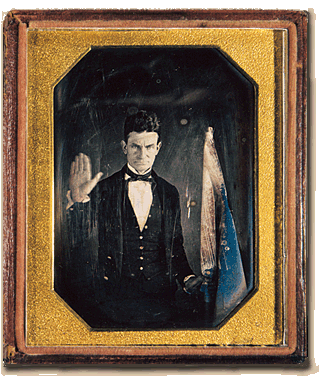
 Abolitionist John Brown was hanged for treason 150 years ago this Wednesday. Was he terrorist or hero? Maybe both. Let us examine what led to his demise.
“I, John Brown, am now quite certain that the crimes of this guilty land will never be purged away but with blood” (Hearn 39).
The fiery, fifty-nine year-old abolitionist wrote these impending words only hours before he was to be hanged for treason, murder, and inciting insurrection.
Only six weeks earlier, the man had been on the verge of successful revolution, a rebellion he envisioned would forever change the course of slavery in
America.
After quickly and covertly seizing his objectives during his infamous raid on
Harpers Ferry, Virginia, his plan quickly capitulated soon after.
Brown planned to capture the U.S. Government-operated arsenal, enlist and arm neighboring slaves into his “Provisional Army,” and carry out his “Holy War” on slavery southward via
Virginia’s
Shenandoah Valley.
Why did this seemingly strategically sound mission go awry?
Why did Brown show weakness at what could have been his greatest moment?
To determine these, one must look at both the raid’s successes and setbacks.
In retrospect, one can see that John Brown’s hasty tactical errors and sympathy for his hostages were perhaps the greatest contributors to his downfall.
The beginnings of the attack originated over a year before the initial raid. John Cook, one of Brown’s faithful disciples, found housing and employment in the sooty industrial town of Harpers Ferry. There, he came to know the routines of the people who resided in the town, the shifts of the guards, and the schedules of the Baltimore & Ohio (B&O) trains. Brown had his foot in the door. This one-man reconnaissance mission was a brilliant plan on Brown’s part, but could not save his campaign in the end. With such advance insight, how could all have gone so wrong so quickly?
Old Man Brown, “Captain Isaac Smith,” arrived in nearby Sandy Hook, Maryland on July 3, 1859 to observe and plan his daring plot in person. He and several of his devotees quietly moved to the recently vacated Kennedy Farm some five miles north of the town (Hearn 8). For the next two and one half months, Brown used this small log cabin as a headquarters for invasion. Over the course of the humid summer and fall, some twenty men concealed themselves in the cramped attic for the majority of their occupation. Brown posed as a cattleman and even invited his daughter and daughter-in-law to the farm to give the appearance of a normal family residing there. Thanks to the funding of Brown’s “Secret Six,” passionate abolitionists who funded Brown, the raiders acquired 200 sharps carbines, 200 revolvers, and nearly 1,000 pikes to be utilized by slaves with little firearms experience. All the pieces were fitting together for Brown, but how would he recruit this new army? This dilemma, Brown would soon discover, would be far more difficult to resolve than originally thought. In August, Brown met with Frederick Douglass at a remote quarry near Chambersburg, Pennsylvania to discuss their course of action. Douglass was not impressed by Brown’s plan or his method of violence. Dismayed, Douglass remorsefully told Brown he was walking into “a perfect steel trap” (Frye 18). However, others were more convinced that Brown’s mission could in fact succeed. Shields Green, a former slave and confidant of Douglass, left Frederick Douglass’s side at this secret quarry summit to fight with Brown. “I believe I'll go with the old man,” Green confided to his old friend Douglass (Cohen 40).
By mid-October, Brown felt the time for action had come. On the night of the sixteenth, he walked into the Kennedy Farmhouse and confidently stated, “Men, get on your arms. We shall proceed to the Ferry.” The army of eighteen solemn men stockpiled weapons in a wagon and set forth in the chilled October mist at approximately eight o’clock that evening (Frye 19). Around 10:30, the small caravan reached the dimly lit industrial crossroads of Harpers Ferry. The team worked like clockwork. Within minutes they had seized two bridges, rifle factories, and an arsenal with over 100,000 weapons, all without firing a single shot. Brown’s plan began more successfully than he could have dreamed. At this same time, at Brown’s directive, several of his companions traversed through the Northern Virginia countryside to capture hostages, one of whom included Colonel Lewis Washington, great grandnephew of George Washington. Brown gathered a number of well-to-do (slave holding) citizens as hostages, but hoped to herald a very emblematic message to those in the south by doing so. The raid was not only a strategic strike against slavery, but a symbolic and psychological strike against the hearts and minds of the planter class and southern aristocracy (Hearn 14-15). Brown and his men were striking slavery at its very roots, but it was about to backfire in their faces.
Brown’s master plan soured quickly as the night progressed. A series of colossal errors turned the tables on him and his followers. One of the town’s night watchmen, Patrick Higgins, freed himself from the grip of his abolitionist captors. Higgins halted an approaching Baltimore & Ohio locomotive and warned its passengers of the potential danger. This uproar sparked the curiosity of Hayward Shepherd, the station’s baggage master. John Brown’s son, Owen, saw Shepherd’s silhouette approaching him. When Owen ordered the man to halt, Shepherd fled with haste toward the town. Brown fired his carbine, and a bullet ripped through the escapee’s body. Shepherd slumped onto the train platform, his blood pouring onto its wooden planks. In this unfortunate mortal wounding lies one of the great tragic ironies of the raid. Hayward Shepherd was a free black man (Frye 19).
These shots echoed like thunder in the quiet dead of night. Dr. John Starry rose from his bed and slipped into the darkness to reconnoiter the chaotic situation. The raiders immediately seized Starry and, when learning he was a physician, quickly summoned him to the hemorrhaging Shepherd. When nothing else could be done for the slain baggage master, Brown himself committed a fatal error; he let the doctor go. Starry, later recognized as the “Paul Revere of Harpers Ferry,” then echoed the message of invasion all throughout the countryside (Frye 19). Why did “Osawatomie Brown,” a cold-blooded killer, show such compassion when tactical logic should have inclined him otherwise?
Furthermore, Brown allowed the B&O passenger train to continue to its destination. The conductor of that train telegraphed for military aid at the next station. This combination of errors led to the ringing of alarms throughout the valley. Hundreds of local militia answered the call. This summon for troops was the beginning of the end for Brown’s hopes of tactical victory. Within hours, the “steel trap” which Douglass warned of was about to snap (Frye 20). The abolitionists were completely penned in. The question is, were they prisoners because of fate or prisoners of choice? Did Brown not attempt escape because he was physically trapped, or did he choose to stay in Harpers Ferry out of a yearning for martyrdom in the name of abolition? If Brown’s beliefs resembled the latter, his demise could be considered his only true success in the raid.
October 17 resulted in a tense “no man’s land” atmosphere between the local militia and the raiders. The citizenry became further outraged when their unarmed mayor, Fontaine Beckham, was gunned down by a raider. Afterward, some of Brown’s men attempted to surrender and were promptly executed vigilante style. Dangerfield Newby, an African-American with Brown, was shot through the head with a railroad spike. Townspeople dragged his limp body away from the fighting. They then proceeded to slit his throat from ear to ear, cut off his genitals, poked sticks into his wounds, and sliced off his ears as souvenirs. Finally, they threw him in the nearby “Hog Alley,” where townspeople dumped their garbage for the pigs to devour. The people of Northern Virginia were very clear in their response to slaves in revolt. Within hours, only five of the raiders were left standing. The remaining raiders and hostages took refuge in the arsenal’s fire engine house (Hearn 22).
By the early morning hours of October 18, Colonel Robert E. Lee and ninety U.S. Marines arrived by train at the Ferry. As daylight ascended, Lee’s aide, Lieutenant J. E. B. Stuart, slowly approached the engine house to demand unconditional surrender. Brown replied he would rather die where he stood. With this, the young officer waved his hat in the air as a signal. Two dozen Marines immediately sprang forward. When they failed to collapse the door with a sledge hammer, a large ladder was implemented as a battering ram. A whole was punched in the wood large enough for one man to clamor through. Lieutenant Israel Green was first inside. Spotting Brown, he plunged his flimsy ceremonial sword into Brown’s stomach, hitting a belt buckle and bending his thin blade in half. Green then used the butt of his sword to smash Brown’s head to a point of near unconsciousness. The assault was over in three minutes. All eleven hostages were freed. The five remaining raiders were killed or captured (Hearn 31).
Why did Brown fail? The plan first began to tailspin when free black Hayward Shepherd was carelessly murdered by Owen Brown. Also, John Brown allowed the doctor tending Shepherd to flee, thus resulting in the first alarms of invasion. The killing of unarmed civilians brought the wrath of the locals upon the men of the Provisional Army. In addition, the raiders allowed for a full B&O train to proceed to its destination. Brown had no qualms with the passengers; therefore he let them go. The conductor on this train spread the word of invasion even further.
Brown also showed weakness and sympathy toward his captives. He allowed the families of his hostages to visit, and they gathered knowledge of the raiders’ strength and disposition. He exchanged hostages for hot breakfasts from the nearby Wager Hotel. He permitted hostages to leave and return (Hearn 32). Brown was infamous to some for his cold-blooded murders and hostility. Three years before Harpers Ferry, Brown had overseen the murders of five pro-slavery men at Pottawatomie Creek, Kansas in response to the beating of abolitionist Senator Charles Sumner on the floor of the U.S. Senate. Brown became a guerilla warrior, showing little forbearance to the evil defenders of slavery. Yet at Harpers Ferry, his comparative mercy was perhaps the greatest contributor to his downfall.
John Brown also chose a poor defensive position when it came to the final hours of his insurrection. He took refuge in a small engine house with high and few windows. The raiders were not even able to fire their weapons out these windows without piling items to stand on. His atmosphere became cramped, smoke-filled, and disorienting. Why he instead did not select a larger arsenal building stockpiled with weapons we will never know.
Finally, what became of the slaves, the slaves who would rush to Brown’s aid at his moment of greatest need? These freedom-seeking soldiers were to comprise the army intended to wreak havoc on the slaveholding South. What happened? The word never got out to them. Those slaves who heard of the raid once it was initiated feared repercussions. For those who may have been waiting in the surrounding Virginia hills, it was Brown who never appeared. And one by one they returned to the farms and plantations. This factor was the most lethal component of Brown’s tactical failure.
One week after the raid Brown faced a jury and was soon after found guilty of treason, murder, and insurrection. He was hanged one month later on December 2, 1859. Where the “Old Man” failed in his combat mission, however, he succeeded in his political and social missions (Frye 20). Abolitionists of the North rallied behind him, many canonizing him. Famed author Henry David Thoreau noted with great sadness and reverence upon the morning of Brown’s execution, “Some 1800 years ago, Christ was crucified. This morning, Captain Brown was hung. He is not Old Brown any longer; he is an angel of light” (“American Experience”). But Southerners reviled him and formed militias for fear of further revolts. The die had been cast, and John Brown created one of the final sectional blows to bring the country closer to war. The civil war that did erupt a year and a half later would eventually accomplish what Brown could not: free the slaves. During that conflict, Union troops frequently marched to a popular tune of the day. John Brown's body lies a-mouldering in the grave...his soul's marching on! And in many ways, it still does.
Works Cited
"The American Experience | John Brown's Holy War | People & Events | Henry David Thoreau." PBS. Web. 14 Nov. 2009. .
Cohen, Stan. John Brown: The Thundering Voice of Jehovah. Missoula, Mt: Pictorial Histories Pub. Co., 1999. Print.
Frye, Dennis E. "Purged Away with Blood: John Brown's War." Hallowed Ground (Volume 10, No. 3. Fall 2009): 16-21. Print.
Hearn, Chester G. Six Years of Hell: Harpers Ferry During the Civil War. New York: Louisiana State UP, 1999. Print.